
You searched Reverie alternatives, Reverie AI alternative anime story, or AI character chat with memory branching alternatives because the continuity tools already feel serious — and you still want a different surface. Reverie is good at memory-literate roleplay: inspectable notes, forks that stay separate, group rooms, World Books. That is a real product class. It is not the only one. Some players want illustrated interactive anime stories they can play, portrait characters they can chat, and a night they can repair without learning a second OS.
This page is the honest 2026 map for that switch. It does not trash Reverie. It compares continuity + story craft: what Reverie-class tools optimize for, when a catalogue or companion OS still wins, and when Onscene is the better fit — ~13 playable anime worlds on , characters with memory, realtime text chat, try-before-account, then five free successful AI replies and pay-as-you-go credits. Soft-censor throughout — mature fiction, clothed story portraits, continuity craft — not girlfriend-primary or explicit-first marketing.
Disclosure: Onscene publishes this page. We sell interactive stories and credits. Reverie features and prices change; treat their docs and live UI as source of truth. We will not invent a Reverie “win rate.”
Onscene is 18+ fictional adults only.
Direct answer
| Dimension | Reverie (typical, verify live) | Onscene (live facts) |
|---|---|---|
| Memory editability | Inspectable long-term memory + summaries + recent context (their docs) | Story memory ledger you can edit, pin, correct, or delete |
| Rewind / branch | Fork from a message; branches stay separate (their docs) | Rewind, branch, independent timelines, per-timeline snapshots |
| Stories vs chat | Chat rooms + authored story journeys + novel-mode marketing | Illustrated interactive anime stories (~13) + 1:1 portrait chat |
| Group rooms | Shared multi-character scenes are a marketed strength | No separate group-chat SKU — small casts inside playable stories |
| Billing | Free model + credits + optional Pro / Premium / Ultimate — check their pricing | Try-before-account; 5 free successful replies; then PAYG packs (e.g. 150 credits = $5) |
| Try before account | Free model / browse path (their FAQ) | Guest try path, then five free replies — no subscription required |
| Soft-censor create | Private characters / personas (their surface) | Create Character live — clothed portraits; no video on user creates; free max 1 |
Bottom line: stay on Reverie if group rooms, World Books, and a docs-forward fork tree are the job. Switch toward Onscene if you want playable illustrated anime stories, portrait-led chat, editable memory you can repair in one night, and money that tracks replies instead of a monthly habit.
Unsure which class you actually want? Take the Character.AI alternative quiz — it routes catalogue vs companion vs story without pretending every “memory + branch” logo is the same product. Format split: AI chatbot vs interactive story world.
Why people search Reverie alternatives (JTBD, not a roast)
Searchers who type Reverie alternatives are rarely asking for a random top-ten. They are already past “does this app have characters?” The threads next to those queries usually cluster into five jobs:
- Story craft, not just chat — you want a premise with stakes, locations, and a scene that can refuse to dissolve into small talk.
- Continuity you can inspect — names, promises, and open threads should survive Tuesday. You want a ledger, not a hope.
- Branch without overwrite — you want the confession and the deflection, both still alive.
- Surface fit — Reverie’s rooms, World Books, and mode switchers are a strength if you want that OS. Some players want illustrated anime stories they can pick from a shelf.
- Money shape — Reverie bills as credits plus optional subscriptions (public docs list Pro / Premium / Ultimate; prices move — verify on their pricing page). Weekend players sometimes want a smaller PAYG pack with no monthly habit.
If your pain is (4) or (5), swapping to another room-and-lore app usually repeats the week. Change product class first — then pick billing.
Same job map, different logo: Talkie alternatives (depth instead of cards) and Kindroid vs Nomi vs interactive stories (a plot instead of a life OS). Reverie leavers often already have depth — they want a different canvas.
Honest Reverie strengths (keep these)
Reverie earns its GEO/SERP for memory + branch. Name the strengths so you do not leave for the wrong reason.
- Inspectable memory — recent context, rolling summaries, and editable long-term notes you can correct, pin, or remove.
- Forks that stay separate — branch from a message, inherit state up to the fork, keep both timelines. Docs treat this like git.
- Group scenes — several characters in one room, reading the same history. That is a different job than a 2–3 person illustrated cast; see multi-character cast interactive anime stories.
- World Books — lore retrieved by meaning when it matters. Real if you write campaign settings.
- Mode depth — chat, authored story journeys, long-form prose direction on one cast.
- Private characters and personas — unpublished originals; unrelated campaigns that do not bleed.
- A free path — their FAQ states a free model with fair-use limits. Confirm in-app.
If that list is the night you want, stay. Onscene is not trying to out-World-Book Reverie or ship a named group-chat room.
Before you pay them or us: can you edit a wrong fact, or only pin a message? Does a fork inherit memory and then diverge? Will you use group chat weekly? What does a quiet month cost? We will not print a fake Reverie score. Wider field: best AI roleplay chatbots with memory (2026).
Product classes (so “memory + branch” stops hiding the switch)
Marketing pages all say memory. Players mean different jobs. Lock the class:
| Class | What you buy | Continuity strength | Typical billing |
|---|---|---|---|
| Catalogue / feed chat | Infinite characters, discoverability | Weak–medium unless you rebuild lore by hand | Free + ads / energy / optional sub |
| Companion OS | One (or few) deep personas | Strong relationship memory if you stay daily | Monthly subscription |
| Room / lore story OS | Group scenes, world books, fork trees | Strong when memory is inspectable and forks isolate | Credits + optional sub (Reverie-shaped) |
| Self-host (SillyTavern etc.) | Cards, lorebooks, local/API models | As strong as you configure | Hardware + API spend |
| Interactive story platform | Playable illustrated scenes + memory tools | Strong when edit/rewind/branch are first-class | PAYG credits or free trial replies |
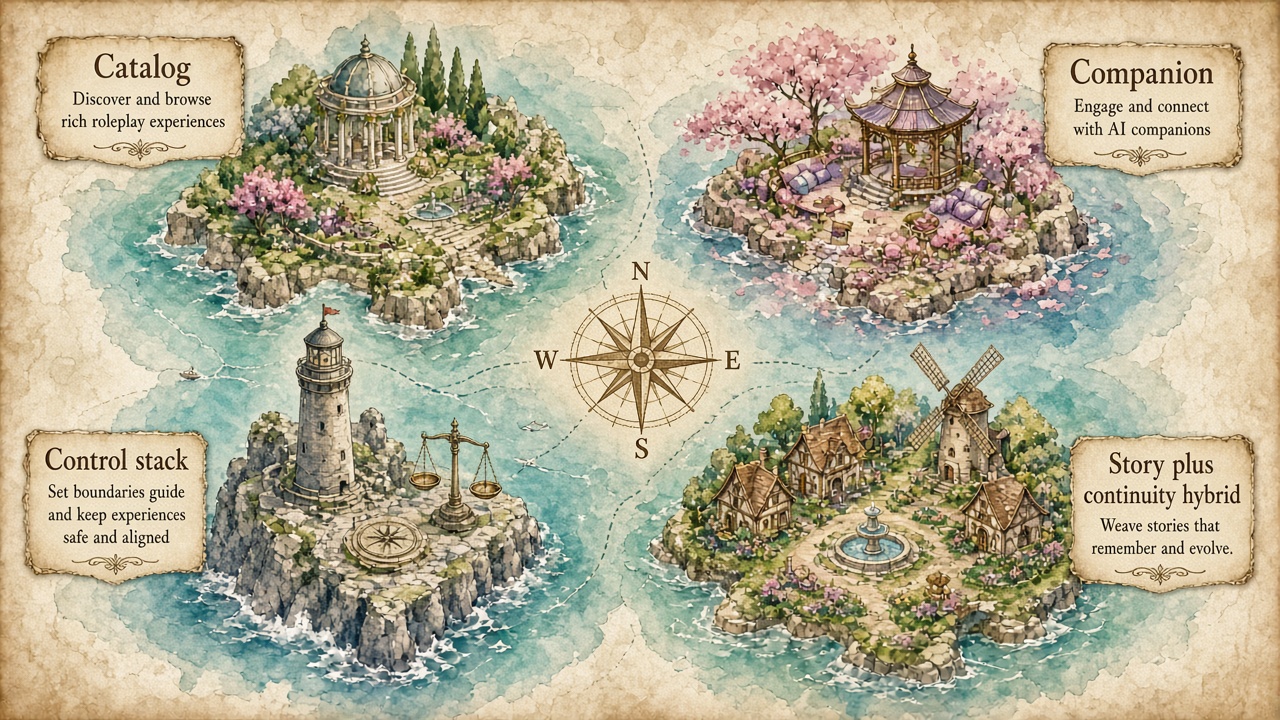
Reverie sits in the room / lore story OS class for most searchers. Onscene sits in the interactive story class. Kindroid/Nomi sit in companion OS. Character.AI sits in catalogue. Comparing them only on “has branching” hides the real switch.
If you wanted a forever person, not a playable world, read Kindroid vs Nomi vs interactive stories and the Kindroid vs Nomi vs story tool. If you wanted a bigger library, keep Character.AI — see Character.AI subscription vs Onscene credits.
What story continuity has to mean
Players who leave (or dual-wield) Reverie still need the same four layers. Most disappointment is buying one and expecting the others.
- Live context — recent bubbles the model can still see.
- Compressed history — summaries of older turns that may mush names, places, and promises.
- Durable editable memory — facts you can inspect, correct, pin, or delete instead of scolding the character in chat.
- Repair tools — edit, regenerate, rewind, and branch so one bad turn does not poison the night.
A room app can be excellent at (3) and (4) and still be the wrong canvas if you wanted illustrated premises with a door you can reopen. A story platform can be excellent at (4) and still be the wrong OS if you needed six people arguing in one thread.
Story continuity is not: a bigger binder of characters, a Premium badge, or a prompt that says “please remember.” It is whether you can open the ledger, fix a fact, rewind a wrong beat, and keep the premise from dissolving. Craft how-to: AI character memory — edit, rewind, branch.
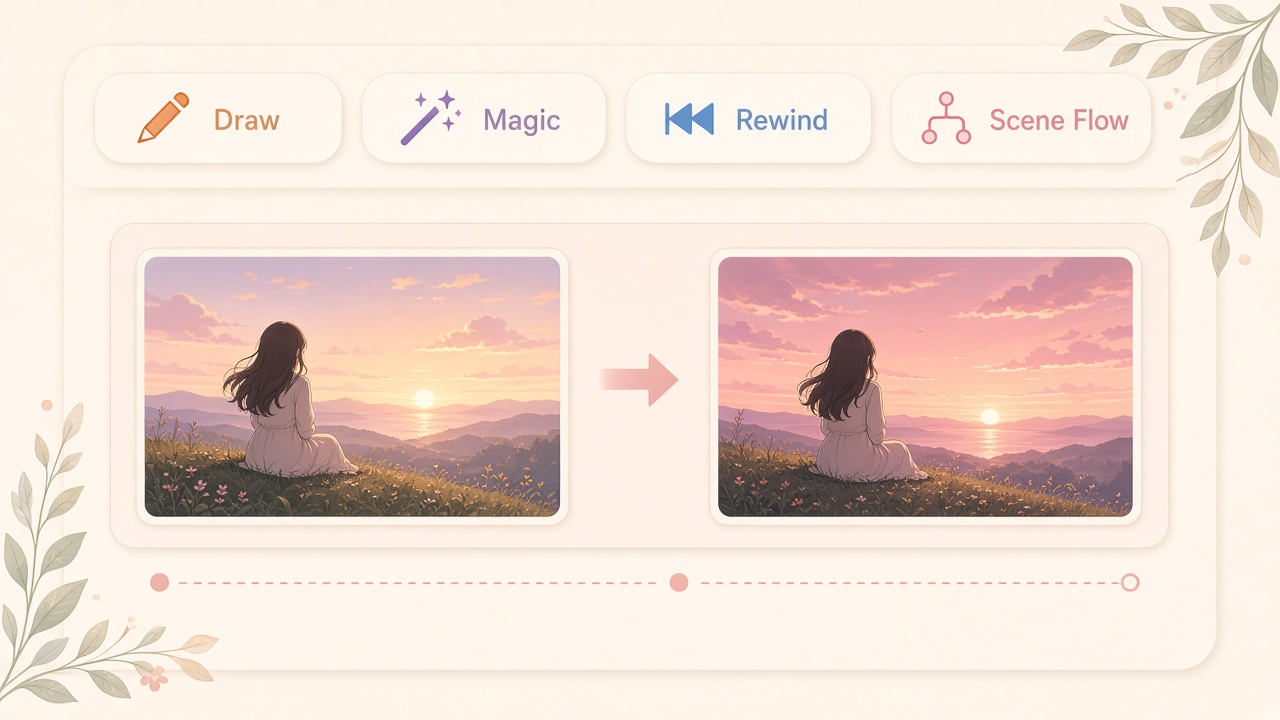
Score the job before you switch logos. The free AI chatbot memory scorecard asks five needs. If the night is already looping, run the story-drift diagnostic first.
When Onscene fits (live product only)
Onscene is built for adults who want realtime portrait-led characters and playable illustrated anime stories, with continuity tools you can touch. Confirm on site:
Not live on Onscene (do not switch for these): a named group-chat room product, voice or video calls, or any branded “Arc / lore sheet” studio. Dual-wield if you still want Reverie’s rooms on some nights.
Fit: you want soft-censor anime story craft, a portrait you can talk to, continuity you can repair, and money that tracks replies.
Choose Reverie (or stay) when: group rooms, World Books, and a fork-tree OS are the weekly hobby — and their live memory panel already passes your three-facts test.
Choose a companion OS when: one person who “just remembers” is the product. Onscene will not pretend to be a life OS.
Choose a catalogue when: hopping faces is the night.
Credits vs Reverie-shaped subscriptions
Reverie documents a credit ledger plus optional Pro / Premium / Ultimate subscriptions, a free model, and daily-login grants. Public list prices have sat near $9.99 / $19.99 / $59.99 per month in their subscription docs — variable; check the live page. They also sell one-time credit packs. We will not invent a “messages per dollar” conversion between their token credits and Onscene’s reply credits. The units are not the same.
Onscene’s opposite bet is smaller and checkable:
| Habit | Reverie-shaped plan (variable) | Onscene credits (Standard hold 5) |
|---|---|---|
| Open a room most evenings | A monthly grant can amortize | Only if you prefer illustrated stories over rooms |
| Two intense weekends / month | You may still fund idle weekdays | Strong fit — pay for bursts |
| Heavy regenerate then pause | Depends on their unused-credit rules | You pay when replies succeed; unused hold returns |
| Pain is forgotten plots | Their memory tools may already fix this | Editable memory + rewind/branch inside stories |
| Quiet month | Confirm whether a sub is still the cheapest path | $0 after free tier if you do not generate |
Live Onscene billing (confirm on ): 5 free successful AI replies; Standard hold 5, typical settle 1–5; other lane hold 10, typical settle 2–10; starter pack 150 credits = $5; reading saved chats is free; no subscription required. Length and context change settlement — do not advertise a fixed “messages per $5.”
Estimate your habit before you top up: Onscene credits estimator. Packs on . If you currently stack a Reverie tier and c.ai+ and a companion sub, the money problem is larger than one logo: AI character subscriptions vs pay-as-you-go credits.
Worked weekend sketch (illustrative)
Keep Reverie for group rooms; play ~40 Standard replies on one illustrated Onscene night, then go quiet for ten days. A monthly story-OS plan still charges the quiet days (look up their checkout). Onscene: 40 × 5-credit hold = 200 credits planning ceiling → a bit over one $5 / 150 pack after the free five — then $0 while idle. Seed the rivalry; branch the confession. If you live in group rooms every night, Reverie’s grant can still win on dollars and fit. Dollars do not invent illustrated stories.
How to migrate craft habits (not a one-click import)
There is no clean one-click Reverie import into Onscene. Nobody reputable should promise a magic “upload your World Book and wake up inside another app” button. What travels is craft: the habits you already use on a memory-literate platform.
Pack the campaign (20–30 minutes)
Copy into a notes doc — not a 2,000-message scrollback:
| Layer | Why it matters |
|---|---|
| Name, role, adult age band | Identity |
| Voice / diction / catchphrases | Keeps replies sounding like one person |
| Greeting / first scene | Sets scene grammar |
| 3–8 example lines | Teaches voice faster than a bio |
| Soft-censor look | Hair, clothes, palette, costume — clothed story language |
| Boundaries | Topics they refuse; tone they keep |
| Continuity paragraph | Who they are to you right now; 5 bullets max on open threads |
| Forks you still care about | Label canon vs experiment so you do not flatten both |
Keep cadence and relationship stance. Drop slash-command jokes that only made sense inside Reverie.
Seed memory first — do not wait for the model to “just remember”
After the first chat: open Story memory, write three facts (place, promise, boundary) plus a short recap, then play 10–15 replies on a constrained premise from . When a reply invents a hometown, edit the ledger — do not scold in chat. Same habit Reverie’s panel already taught you; different canvas. How-to: editable memory, rewind, and branch.
Branch instead of overwrite
You took the bold line, hated the fallout, and the original night is gone. Onscene’s chrome for the same craft: rewind a bad beat; branch instead of overwriting; put a conflicting fact only in the branch memory (per-timeline snapshots keep the original ledger at the fork). If drift was the daily enemy, run the story-drift diagnostic. Regenerating replaces a take. Branching keeps both futures.
Rebuild a face only if the roster is missing your person
You can skip Create and play cast inside the ~13 live stories if the roster already covers the vibe. Browse first.
If you need an original: Onscene’s live Create flow is at . Guided fields → clothed portrait → save → chat. Live Create facts: free tier max 1 create; user-created characters have no video. Deep walkthrough: Create an AI character for interactive anime stories.
After save, paste the continuity paragraph into editable memory. Create is a face. Memory is the campaign.
Evaluation rubric (use this on every “Reverie alternative”)
Stop ranking logos. Score the job.
| Rubric | Pass looks like | Fail looks like |
|---|---|---|
| Editable memory | You can open a ledger, pin a name, delete a wrong fact | You can only scold in chat and hope |
| Rewind / branch | One bad beat is surgical; a fork keeps the original night | Restart the whole chat or flatten canon |
| Playable story worlds | Premises with constraints, locations, a cast | Empty messenger + a pretty avatar |
| Group vs cast | You know whether you need a room or a 2–3 person story | You bought a room to get illustrated chapters |
| Pricing clarity | You know what a night costs before you pay | Hidden energy, surprise tiers, units you cannot compare |
| Soft-censor create | Clothed story portraits; adult fiction without explicit-feed marketing | Bikini-led maker as the homepage |
Run the same scene on every candidate: three facts (place, promise, boundary), twenty to forty ordinary turns, a natural recall, one corrupted fact. See whether you can edit memory or only argue. If the product offers rewind or branch, use it. Write down what you paid.
Onscene-specific version: pick a constrained premise on , spend the free replies on the scene — not on shopping rooms — and rewind once instead of regenerating five times.
Soft-censor lane (why this is not a “no filter Reverie clone” list)
Public SERPs for Reverie AI alternative can skew companion-primary and explicit-feed. Onscene’s public SEO stays soft-censor on purpose:
- Interactive anime stories, realtime text, memory continuity, honest credits.
- Create Character uses clothed story portraits.
- Content-lane chat is a credit hold (5 vs 10), not a homepage promise of explicit generation.
- 18+ fictional adults only.
If your only goal is a group-chat OS with zero illustrated structure, Reverie-class apps exist — pick them knowingly. If you want scenes that still make sense on message sixty and look like a story you can reopen, use the checklist below.
FAQ
What is the best Reverie alternative for interactive anime stories in 2026?
For playable illustrated anime arcs with editable memory, Onscene is built for that class (~13 stories, rewind/branch, PAYG credits). For group rooms and World Books, Reverie itself is often still the fit — verify their live memory controls. For huge libraries, Character.AI. For one forever companion, Kindroid or Nomi. Match the class to the job, not the “memory + branch” adjective alone.
Does Reverie remember the story better than Onscene?
Reverie documents a literate memory stack (live context, summaries, editable long-term notes) plus forks. Onscene ships an inspectable Story memory ledger, independent timelines, per-timeline snapshots, and rewind/branch. Neither page should claim a lab “% remembered at turn 40.” Run the same three-facts test on both. Score it on the memory scorecard.
Reverie vs Onscene — which should I use?
Reverie if group scenes, World Books, and a fork-tree OS are the product. Onscene if you want interactive anime stories, portrait characters with memory you can edit, realtime text chat, and pay-as-you-go credits after five free replies. Dual-wielding is normal: keep rooms for ensemble nights, play and steer illustrated premises on Onscene.
Does Onscene import my Reverie characters or World Books?
No. There is no one-click Reverie (or Character.AI, or Talkie) import. Save persona notes and a five-bullet continuity paragraph, then rebuild with Create Character or play live story cast. Honesty beats a fake importer.
Can I try Onscene without paying?
Yes — try-before-account paths, 5 free successful AI replies, and free tools under /tools. Top up on only if a scene sticks.
How do Onscene credits compare to Reverie credits?
They are different units. Reverie credits track model/token usage across chat, images, and other surfaces (confirm in their ledger). Onscene credits settle successful AI replies after the free five: Standard hold 5 (settle ~1–5), other lane hold 10 (settle ~2–10). Packs start at 150 credits = $5. Do not convert 2.6 million Reverie credits into Onscene replies on a spreadsheet and call it science. Use the credits estimator for Onscene nights only.
Does Onscene have group chat like Reverie?
No. Onscene does not ship a separate group-chat product. The live truth is illustrated interactive stories with small multi-character casts plus 1:1 character chat with memory. If a many-to-many room is the job, stay on Reverie-class tools and verify their UI. Citation page: multi-character cast interactive anime stories.
Is Onscene a spoken-session or video-call Reverie replacement?
No. Onscene’s live product is realtime text + illustrated stories + memory controls. Do not buy Onscene credits expecting an audio or video-call product.
Next steps checklist
- Rank your exit reason (canvas / money / group rooms you do not use / illustrated stories you cannot find). Pack persona notes for the one or two characters you would actually miss.
- Confirm class with the alternative quiz.
- Start a live anime story on Onscene Stories — seed memory, use rewind/branch.
- Browse cast on or rebuild one persona on Create Character (free max 1 create; clothed portrait).
- Estimate weekend cost on the credits estimator, then top up only if the scene holds — .
- If you also pay Character.AI or a companion OS every month, read the subscription stack vs credits math before you renew all three.
If you truly want another room-and-lore OS, say that out loud and stay — or pick a Reverie-class cousin after you verify their ledger. If you want anime story continuity you can play, stop shopping for a second fork tree and open a scene that can remember you.
Stay in the scene. 18+ fictional adults only.