
Kindroid vs Nomi is a companion-OS comparison. Both products sell a persistent relationship with long-term memory marketing, voice-forward companionship in public positioning, and a monthly plan as the serious path. Pick Kindroid if you want layered / editable learned context and a companion that is the product. Pick Nomi if you want lower-setup companionship with a mind-map / shared-notes memory UX. Pick neither if what you actually wanted was a playable illustrated story with inspectable memory, rewind/branch, and pay-as-you-go credits instead of another companion subscription — that third path is Onscene.
This page exists because search results for kindroid vs nomi are already full of essays that treat those two as the whole market. They are not. They are the companion duopoly. Interactive stories are a different job. Onscene only wins this comparison when story + memory + credits is the job you have.
Disclosure: Onscene publishes this article. We are biased toward playable stories. Competitor features and prices are labeled as their public docs/marketing from fetched pages, not as Onscene lab results. Verify on each vendor’s site before you pay.
Onscene is 18+ and fictional. Soft-censor framing: romance, mystery, long-running companionship, and scene craft — not explicit-first marketing.
Direct answer: companion OS, companion OS, or playable story?
| Your actual job | Lean toward | Why |
|---|---|---|
| One relationship that deepens for months; memory is the product | Kindroid or Nomi | That is what they sell |
| You will talk daily and want a bundled companion plan | Kindroid or Nomi subscription | Idle weeks still feel “worth it” if you show up every day |
| You want to direct a scene with stakes, not only keep a person | Onscene stories | Premises, story controls, rewind/branch |
| You hate another $14–$16/month that you barely open | Onscene credits | 5 free replies, then packs; 150 credits = $5; idle weeks = $0 |
| You want maximum local control | SillyTavern + your model | Not in this three-way, but it still wins power-user |
| You still want a giant public bot catalogue | Character.AI / Chai / PolyBuzz-class | Neither Kindroid, Nomi, nor Onscene is a catalogue giant |
If Kindroid vs Nomi already describes your life — one companion, daily check-ins, memory as the product — stay there. This article will not pretend Onscene is a better Kindroid. It will tell you when a playable story is the missing third option.

What “companion OS” means (and why it is not a story engine)
A companion OS is software whose center of gravity is a person who persists. Typical public promises:
- Long-term memory layers (short / medium / long, cascaded, or mind-map).
- Editable notes, backstory, or learned context you can curate.
- Daily presence: messages, reminders, voice in marketing, sometimes selfies or “life” simulation.
- A subscription that assumes you will keep the same companion open.
That is a real product. Many people searching kindroid vs nomi want exactly that. They did not ask for a visual novel. They asked which companion remembers better.
A playable story is a different center of gravity:
- A premise with constraints (the train resets; the inn leaves the mountain; the court has a clock).
- A cast, not only a dyad.
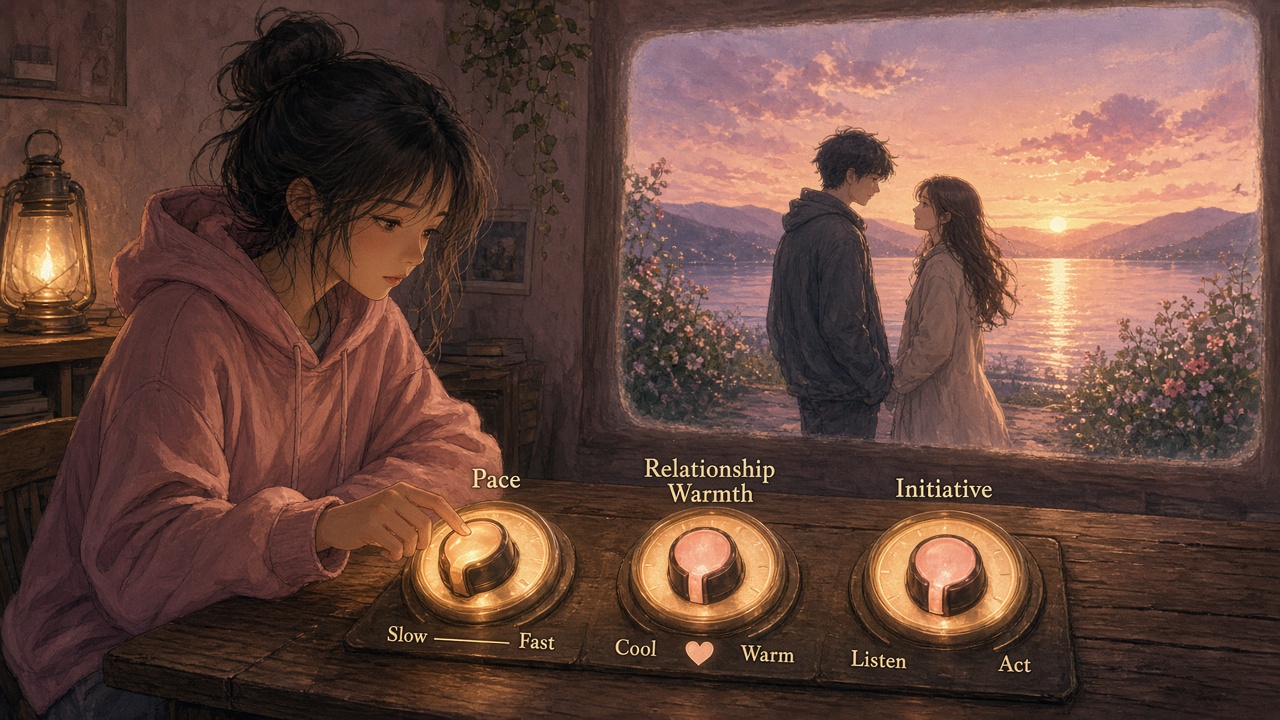
- Director tools (pace, initiative, relationship warmth, length) so the scene does not dissolve into small talk.
- Repair tools (edit, regenerate, rewind, branch) so one wrong beat does not own the night.
- A catalogue of worlds you can start, pause, and resume — not one OS you live inside.
Onscene ships the second shape: interactive anime stories on /stories (~13 playable worlds) plus portrait-led character chat on /characters with memory you can edit. Realtime means responsive text + portrait presence today. Voice/video calls are positioned as coming later — do not buy credits “for calls.”
If you wanted the first shape, Kindroid or Nomi is the honest shortlist. If you wanted the second, comparing only those two will keep you stuck in companion essays.
Kindroid — when the companion OS wins
Kindroid’s public docs and marketing emphasize layered / cascaded long-term memory and editable learned context. In 2026 roundups it often wins “persistent companion” recommendations for people who want one relationship to deepen, not fifty characters to sample. Voice-forward companionship is part of how the product is sold.
Strengths (cite as their positioning, then verify):
- Memory as a first-class companion feature, including editable learned context in public docs.
- A product loop that assumes this person is the destination, not a scene you finish.
- Users who write every day often prefer a monthly companion plan to metered story nights.
Friction:
- Less “anime illustrated story hub” than story-first apps. Confirm whether director-style story worlds are their center of gravity before you migrate a campaign.
- Free tiers are typically tight; serious use is subscription-shaped.
- Optional Ultra/MAX-style memory add-ons can stack cost on top of Premium.
Public pricing (approx., USD): Kindroid Help Center has documented web Premium around $13.99/month (or multi-month/year discounts) and higher App Store prices (about $15.99/month), plus optional memory add-ons — see Kindroid subscriptions docs. Treat checkout as truth.
Choose Kindroid when: you want a companion OS, you will actually talk daily, and editable learned context is the feature you will use.
Look at Onscene instead when: you keep trying to plot inside a companion chat and the scene still drifts; you wanted illustrated premises; or you resent paying for a month you barely open.
Versus Nomi: Kindroid often reads as the more configurable companion (more knobs, more add-on surface). Nomi often reads as the gentler on-ramp. Neither is a story engine.
Nomi — when low-setup companionship wins
Nomi is frequently recommended as the easy kindroid vs nomi answer: short-, medium-, and long-term memory concepts plus mind-map / shared-notes style interfaces in public positioning. That lowers the barrier for players who will never write a lorebook or a cascaded memory scheme.
Strengths (their positioning, then verify):
- Approachable persistence. You are not asked to become a prompt engineer to feel remembered.
- Strong reputation in companion-memory shortlists for “they still know me.”
- Credit packs for extras on top of the subscription — useful if you buy specific add-ons, not if you wanted a fully metered story product.
Friction:
- Director tools (pace, initiative, branch hygiene) and illustrated story worlds are not the center of gravity.
- Subscription is the main path for heavy use. Light or burst players pay for calendar time.
- If your complaint was “I wanted a plot,” a better mind-map will not invent a premise.
Public pricing (approx., USD): Apple App Store listings have shown Standard Plan $15.99, Standard Plan Quarterly $39.99, Standard Plan Yearly $99.99, plus credit packs for extras — Nomi on the App Store. Android/web checkout can differ. Verify live.
Choose Nomi when: you want companionship with less setup than Kindroid, and memory UX is the reason you opened the comparison.
Look at Onscene instead when: you want to play a world tonight, fix a wrong turn with rewind, and stop paying when you stop playing.
Versus Kindroid: Nomi is often the “just works” companion. Kindroid is often the “I will tune this” companion. Try both on the same three facts (place, promise, boundary) before you declare a winner — companion chemistry is personal.
Onscene — the playable story third path (only when it wins)
Onscene is built for adults who want realtime portrait-led characters and playable illustrated stories, with continuity tools you can touch. It is not a Kindroid clone and not a Nomi clone.
Shipped today:
- Interactive anime stories on /stories (~13 playable worlds with premises and constraints).
- Characters with editable memory, independent timelines, and edit / regenerate / rewind / branch.
- Story controls — relationship, pace, initiative, style, length — so you direct instead of begging in parentheses (story controls guide).
- Realtime chat as streaming / responsive text + portrait presence (realtime explained).
- Try-before-account: guest character chat at www.onscene.fun (a few free messages, no card).
- Five free successful AI replies after you sign in, then credits. Standard hold 5 available credits to start a reply; the other content lane holds 10. Unused hold returns. Length and context change settlement. 150 credits = $5 starter pack. Reading saved chats is free. No subscription required. (Credits, credits explained.)
Not shipped / not claimed here: live voice or video calls (coming later), in-app Create-character UI as the primary play path, or a companion “life OS” with daily voice check-ins as the main loop. Do not migrate from Kindroid expecting Onscene to be the same product with prettier art.
Choose Onscene when all of these are true:
- You want a premise, not only a person.
- You will actually use rewind/branch or editable memory when a turn goes wrong.
- You play in bursts (weekends, one campaign) more than every-day companion check-ins.
- Pay-as-you-go is a feature, not a compromise.
Stay on Kindroid/Nomi when: the companion is the hobby, voice-forward daily presence is the point, or you already paid a year and the memory is working.
Comparison table (Kindroid vs Nomi vs Onscene)
No fake scores. Feature orientation only. Companion claims are their public posture.
| Dimension | Kindroid | Nomi | Onscene |
|---|---|---|---|
| Product class | Companion OS | Companion OS | Story + continuity hybrid |
| Center of gravity | One persistent relationship | One persistent relationship, lower setup | Playable worlds + portrait chat |
| Memory posture | Layered / cascaded + editable learned context (their docs) | Short/medium/long-term + mind-map / notes (their positioning) | Editable memory; per-timeline snapshots; rewind/branch |
| Story depth | Companion-first; confirm any VN-style hub yourself | Companion-first | Illustrated playable stories (~13) + chat |
| Repair tools | Product-specific; verify edit surfaces on their site | Product-specific; verify notes/mind-map | Edit, regenerate, rewind, branch (shipped) |
| Director tools | Not the category’s usual promise | Not the category’s usual promise | Relationship / pace / initiative / style / length |
| Realtime today | Voice-forward companionship in their marketing | Voice-forward companionship in their marketing | Responsive text + portrait presence; calls coming later |
| Billing | Monthly companion plan (~$13.99–$15.99/mo + add-ons) | Monthly / yearly plan (~$15.99/mo or ~$99.99/yr) + extra credits | 5 free replies, then PAYG; 150 credits = $5 |
| Best fit | Daily companion, tunable memory | Daily companion, gentle on-ramp | Burst story nights, inspectable continuity |
| Weak fit | Players who wanted a plotted VN | Players who wanted a plotted VN | Players who wanted a voice companion OS |
For a wider field that includes Character.AI, DreamGen, SillyTavern, Reverie, and others, use the 2026 memory roleplay shortlist. For catalogue exits (Chai, Character.AI), use the fit quiz and Chai alternatives for story continuity.
Money: two subscriptions vs one credit pack
Kindroid vs Nomi money is usually “which monthly fee.” Both live in the mid-teens per month on public store/web lists, with yearly discounts and optional extras. That is cheap per day if you open the app daily. It is expensive per night if you wanted two story sessions in September and then vanished.
Onscene’s planning facts (live on /credits):
- Five free successful AI replies when you join (including regenerations).
- After that, Standard needs 5 available credits to start a reply; the other lane needs 10. Unused hold returns.
- Starter pack: 150 credits = $5. Larger packs exist with a slightly better credit-per-dollar rate.
- No recurring charge is created by buying a pack.
- Reading saved chats is free — rereading continuity is not a tax.
Sketch your habit on the credits estimator. Do not trust a blog (including this one) for a fake messages-per-dollar guarantee. Settlement depends on length and context.
Pick a companion subscription when: you already know you will talk every day and want the bundled companion features those apps market (including voice in their products).
Pick credits when: you play in bursts, you regenerate when a beat is wrong (rewind is cheaper than five regenerations), or you are still testing whether story-first even fits.
Deeper subscription-vs-credits math vs Character.AI Plus lives in Character.AI subscription vs Onscene credits. The estimator is the interactive version.
A fair Kindroid vs Nomi vs Onscene test
Use the same scene everywhere. Companion chemistry is personal; this ritual at least compares continuity and steering.
- Establish three facts: a place name, a promise, a boundary.
- Play twenty to forty ordinary turns (not a memory exam every message).
- Ask naturally about the three facts.
- Corrupt one fact on purpose. Can you edit the ledger, or only scold in chat?
- Fork the night if the product allows it. Does the original timeline stay clean?
- Try to change pace or initiative without writing a paragraph of stage directions. If you cannot, you are in a companion messenger, not a story engine.
- Note voice/call features only if they are actually live for you — do not assume Onscene calls exist today.
- Write down the price of that night: a fraction of a monthly sub vs credits vs free tier.
If Kindroid or Nomi wins steps 3–4 and you never needed step 6, you belong on a companion OS. If step 6 is the whole reason you searched kindroid vs nomi, you were in the wrong SERP — start a world on /stories.
How to choose in five questions
- Person or premise? Person → Kindroid/Nomi. Premise → Onscene (or DreamGen / SillyTavern if you want a heavier engine).
- Will you edit memory by hand? If yes, prefer products with a visible ledger. Onscene’s version is in the memory craft post.
- Daily companion or weekend campaign? Daily → subscription companion. Weekend → credits.
- Is voice the product? If yes, Kindroid/Nomi-class apps are the shortlist; Onscene calls are coming later.
- Are you shopping spice? Stop. Soft-censor public pages here will not rank that. Match continuity and story craft instead.
Still unsure? Two minutes: Character.AI alternative quiz. It is built for catalogue vs story vs pricing jobs; use it as a sanity check, then come back to this table. A dedicated Kindroid-vs-Nomi-vs-story picker is on the tools roadmap — until it ships, this article plus the quiz is the decision path.
Soft CTAs
- If you want a playable story, not one companion: open /stories and spend 5 free replies on a constrained premise.
- If money is the blocker: credits estimator → /credits.
- If you are still comparing apps like Character.AI / Chai: quiz + Chai continuity alternatives.
- If you already know Kindroid/Nomi fit: stay. Bookmark this page for the day a companion is not enough and a plot has to hold.
FAQ
Who wins Kindroid vs Nomi in 2026?
Neither, universally. Kindroid often wins players who want more configurable companion memory. Nomi often wins players who want a gentler on-ramp and a mind-map style UX. Run the three-facts test on both. If you wanted a playable story, neither “wins” — you were comparing the wrong class.
Is Onscene a Kindroid alternative or a Nomi alternative?
Only when the job is story + inspectable memory + pay-as-you-go. It is a weak Kindroid/Nomi alternative if you wanted a voice companion OS as the main loop. Calls on Onscene are coming later.
Kindroid vs Nomi vs Character.AI — where does that sit?
Character.AI wins catalogue discovery. Kindroid and Nomi win persistent companionship. Onscene wins playable illustrated stories with continuity tools. See the quiz companion longread for the four-job map.
Does Onscene have better memory than Kindroid or Nomi?
We will not invent a recall percentage. Companion apps frequently win “they still remember” shortlists. Onscene competes on inspectable memory and rewind/branch, plus story controls that keep facts from being stranded in a plotless chat. Test it.
How much is Kindroid vs Nomi vs Onscene per month?
Kindroid and Nomi are typically mid-teens USD per month on public lists (Nomi also ~$99.99/year). Onscene has no subscription: five free replies, then credits (150 = $5 starter). A heavy daily Uncensored-lane Onscene user can spend more than a companion sub; a light weekend player usually spends less. Use the estimator.
Can I try Onscene before I cancel Kindroid or Nomi?
Yes. Guest character chat at www.onscene.fun, then five free replies on an account. Do not cancel a working companion until the story path survives the three-facts test. Dual-wielding is normal.
Does Onscene let me build a custom companion like Kindroid?
Do not treat in-app Create-character UI as the shipped primary play path. Play from /characters and /stories. There is no Kindroid/Nomi importer.
Are these apps for adults?
Onscene is 18+ fictional adults only. Kindroid and Nomi set their own age and content rules — read theirs. This page stays in a soft-censor lane: mature scene craft, not explicit-first keywords.
Bottom line
Kindroid vs Nomi is the right search if you want a companion OS. It is the wrong search if you wanted a night with a plot, a ledger you can edit, and the right to stop paying when you stop playing.
Pick Kindroid or Nomi when the person is the product and you will show up daily. Pick Onscene when the scene is the product: interactive anime stories, characters with memory, realtime chat, try-before-account, five free replies, then credits.
Start on /stories if the third path is yours. Stay on your companion if it already remembers Tuesday. Either way, match the job — not the loudest essay in the SERP. 18+ fictional adults only.